


In fast-moving markets, many organizations face a familiar dilemma: you need to deliver a high‑quality web or mobile product quickly, but you also want full ownership, predictable run‑costs, and an internal team that can sustainably evolve the platform. Typical sourcing models create trade‑offs—pure outsourcing can deliver speed but delays capability building; pure in‑house hiring delays delivery and increases risk.
Build‑Operate‑Transfer (BOT) is a pragmatic middle path. With BOT, a specialized partner acts like your temporary product engine: we build the MVP, operate it through the crucial early growth phases, and then transfer a proven codebase, processes, and know‑how to your in‑house team. Done well, BOT aligns with executive priorities—time‑to‑value, risk reduction, governance, and long‑term capability—while still leveraging a custom web app development agency’s velocity and a digital product design agency’s craft.
This article outlines a modern BOT playbook fit for enterprise application development and venture‑backed startups alike. You’ll find concrete steps, artifacts to demand, measurable milestones, and a transfer plan that ensures your team inherits not just code, but a product‑capable operating model.
Event/Performer Details
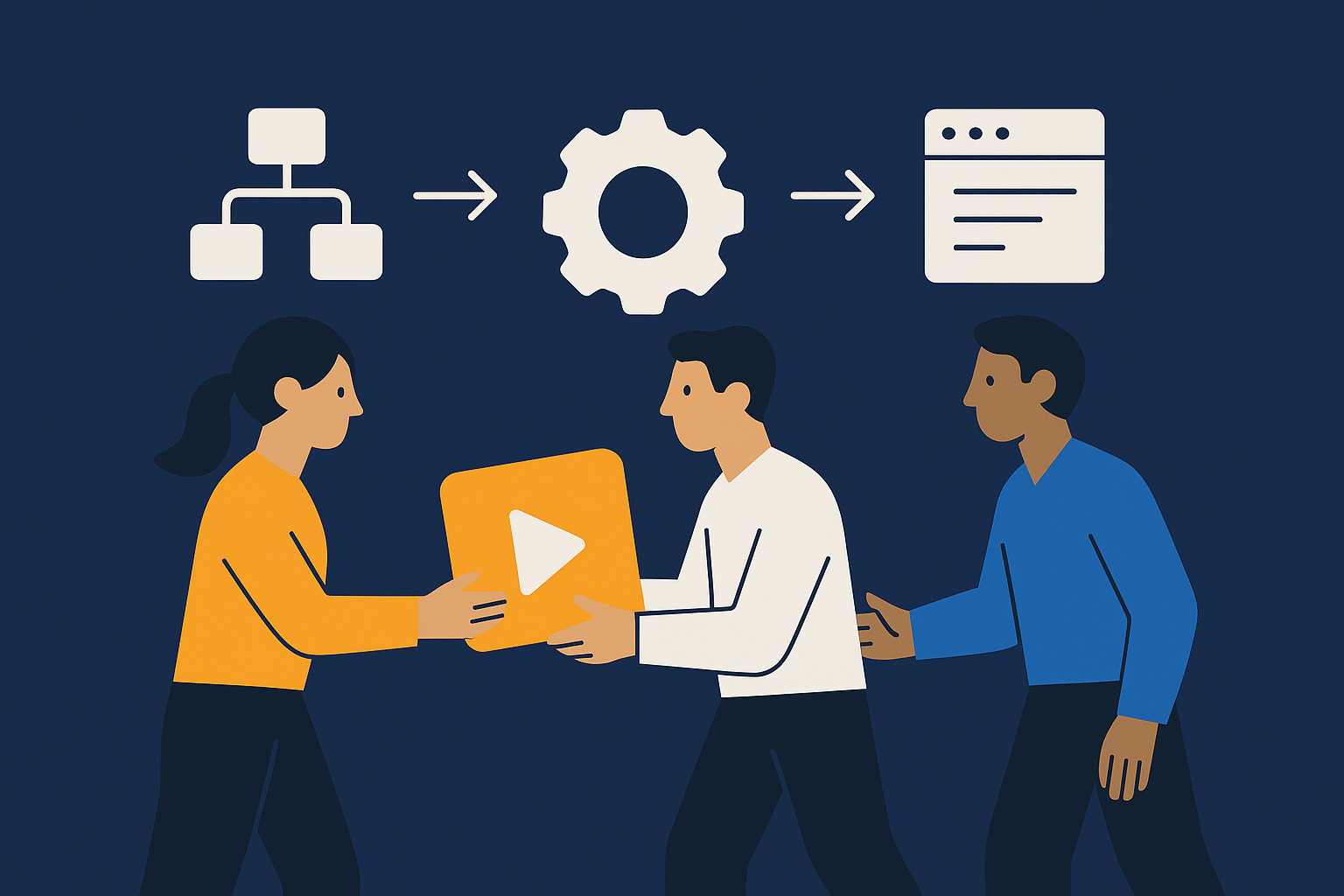
- Model: Build‑Operate‑Transfer (BOT) for digital products
- Scope: Web applications, mobile apps, platform backends, data services, and design systems
- Phases: Build (0–1), Operate (1–n), Transfer (n–∞)
- Primary goals:
- Deliver a market‑ready MVP fast with “operate‑ready” engineering
- Validate product‑market fit and scale with real users
- Transfer ownership, process, and knowledge to your internal product team
- Success metrics: Time‑to‑first‑value, reliability SLOs, security posture, conversion/NPS, cost per feature, time‑to‑recovery, and knowledge transfer coverage
- Where it applies:
- New ventures needing MVP development services with a clear path to in‑house ownership
- Divisions within large enterprises modernizing a core platform
- Organizations consolidating vendors while building product capability
Who does what
- CoreLine (Build, Operate):
- Product consulting and roadmap architecture
- UX/UI design system and research cadence
- Engineering for web, iOS/Android, APIs, and infra
- Operability: CI/CD, observability, SLOs, runbooks
- Governance: security, privacy, compliance scaffolding
- Your organization (Transfer, then Operate):
- Product strategy and prioritization
- Hiring and onboarding internal roles
- Ongoing roadmap, scale‑up, and cost governance
Introduction
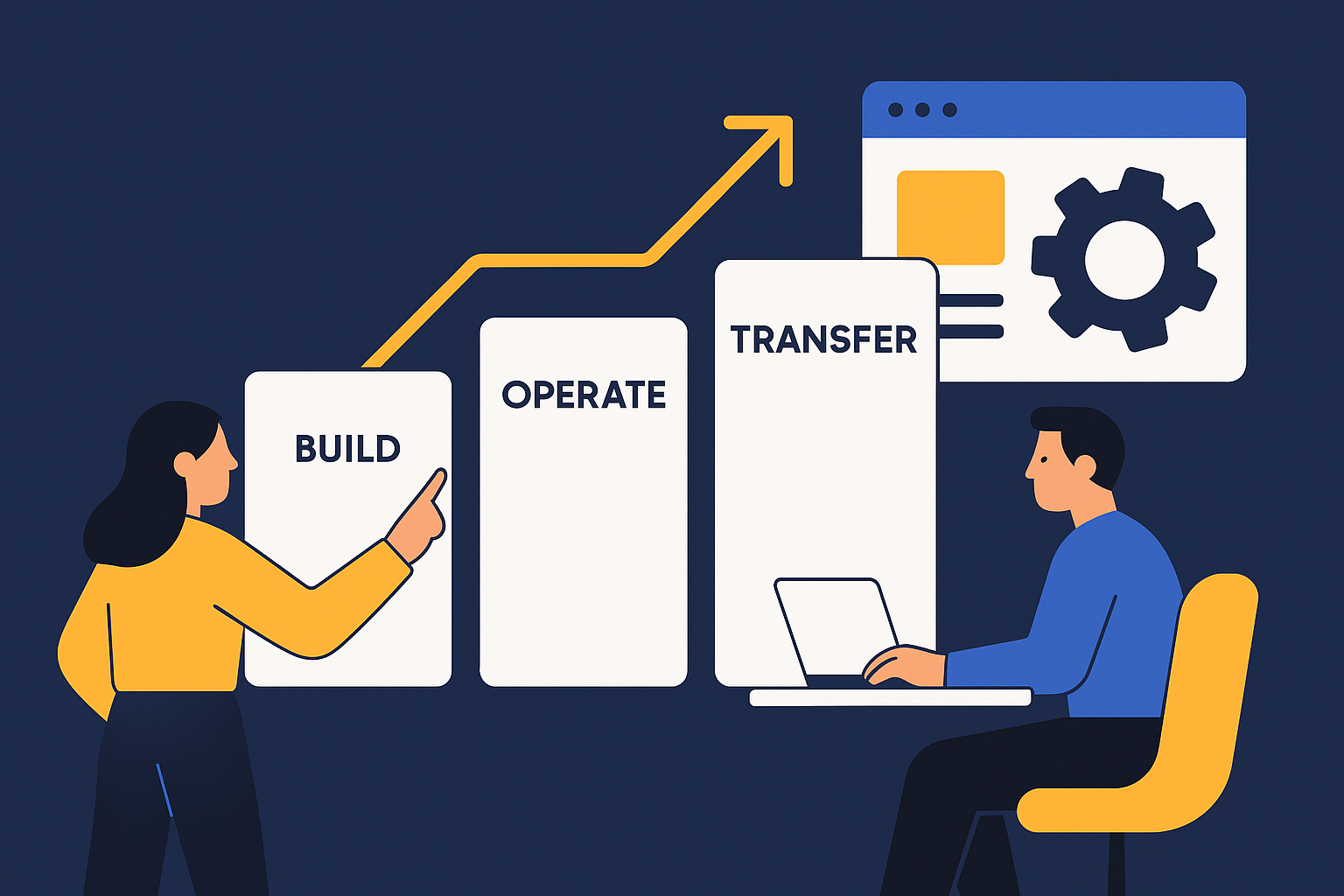
BOT is not staff augmentation with a handoff at the end. It is a governed, time‑boxed partnership designed to leave your team stronger than it started. The “operate” period is crucial: what you operate, you learn to own. That’s why we design the product and its operating model together—so the eventual transfer is a relay, not a restart.
In our experience, the most successful BOT programs start by defining the “end state” first: what team, capabilities, and artifacts will exist when the transfer completes? From there, we plan backward to ensure every sprint, pipeline, and document serves that outcome.
Why You Shouldn’t Miss It
- Executive control: Aligns spend to outcomes while building internal capability on a predictable timeline.
- Faster ROI: Launch an MVP with production‑grade foundations, then scale without costly rewrites.
- Reduced vendor risk: Clear exit criteria, source‑of‑truth documentation, and a staged ownership plan.
- Capability building: Your team co‑authors the codebase, design system, and runbooks from day one.
- Governance baked in: Security, privacy, and compliance patterns included—not bolted on later.
- Cost transparency: Ties to total cost of ownership levers—infra, tooling, licensing, and support.
- Talent acceleration: A hiring plan synced with feature milestones and the transfer window.
The BOT Playbook
Phase 1 — Build: 0–1 with operate‑ready engineering
- Product consulting foundation
- Outcome‑based roadmap: measurable hypotheses, success metrics, dependencies
- Decision cadence: weekly product council; risk/assumption log kept current
- MVP scope with future‑proofing
- Architecture decisions (ADRs) capture trade‑offs and constraints
- Multi‑env CI/CD, IaC, and seeded observability from Sprint 1
- Access control, audit trails, and data lifecycle policies established early
- UX/UI design that compounds
- Tokenized design system mapped to platform constraints (web, iOS, Android)
- Accessibility standards and content guidelines defined upfront
- Research scripts and repository created for repeatable studies
- Engineering guardrails
- Trunk‑based development with short‑lived branches
- Static analysis, dependency governance, and SCA gates
- Test strategy: contract tests for APIs, golden paths for end‑to‑end flows
Why this matters: MVPs often ship fast but leave ops, security, and analytics as “Phase 2.” BOT treats these as Day‑1 concerns so scale doesn’t force a rewrite.
Phase 2 — Operate: 1–n with real users and real stakes
- Operability as a product
- Service‑level objectives (SLOs) aligned to user journeys
- Error budgets guiding prioritization between features and reliability
- Alert policy that favors user impact over system noise
- Growth loops and analytics
- Event taxonomy and governance: every event has a definition owner
- Experimentation protocol (A/B) with a guardrail KPI set
- Funnels, cohorts, and retention reporting baked into dashboards
- Secure‑by‑default habits
- Secrets management, least‑privilege IAM, and automated key rotation
- Data classification tied to logging/redaction standards
- Internal team shadowing
- Pairing schedule: internal engineers, designers, and PMs rotate across squads
- “Brown bag” enablement sessions, recorded and indexed
- Hiring enablement: role scorecards, interview kits, and code exercises
Why this matters: Operating the product under real load teaches the habits your team must own—prioritization with error budgets, progressive delivery, and practical security.
Phase 3 — Transfer: from co‑ownership to independence
- Transfer readiness review
- Codebase and infra access parity for internal leads
- On‑call rotation includes your engineers before full handover
- “You build it, you run it” KPI targets met for two consecutive sprints
- Knowledge transfer artifacts
- Runbooks: deployments, rollback, incident playbooks, data restore procedures
- Architecture maps: domain boundaries, data flows, threat models
- Process docs: release trains, branching, incident review, experimentation workflow
- Training library: recorded sessions, annotated repos, ADR index, glossary
- People and process continuity
- RACI re‑cast for the internal team
- Vendor exits planned: licenses, secrets, accounts, and billing ownership
- Optional “hypercare” period with predefined scope and burn‑down plan
Why this matters: Transfer is a managed reduction in vendor dependency—not a cliff.
Practical Information
Timeline and resourcing
- Typical duration: 6–12 months from first line of code to completed transfer (complex enterprise products may span longer).
- Team shape by phase:
- Build: Product Manager, Tech Lead, 2–4 Engineers (web/mobile/backend), UX Lead, QA, DevOps
- Operate: Same plus Data/Analytics, SRE, and part‑time Security/Privacy counsel
- Transfer: Ramp‑down of partner engineering as your hires ramp‑up; hypercare staffed by leads
Governance and risk management
- Executive cadence
- Monthly steering with CFO/CTO/CMO representation: budget burn, risk register, KPI review
- Quarterly architecture review against business context changes
- Security and compliance
- Security backlog integrated into product backlog, not a side list
- Privacy impact assessments embedded in epic kickoffs
- Vendor management: SBOMs, SCA reports, and dependency policies tracked in CI
- Procurement and contracts
- Outcome‑aligned milestones instead of pure time‑and‑materials
- Explicit IP terms, documentation deliverables, and transfer exit criteria
- Data residency and DR objectives stated early and tested in Operate
Economics and TCO levers
- Build smart, run lean
- Select managed services strategically; avoid lock‑in where portability matters
- Right‑size environments; use cost budgets and tagged resources from day one
- Instrument run‑cost per user or per transaction to inform pricing and features
- Hiring aligned to transfer
- Sequence roles based on risk: Tech Lead and SRE early; specialized roles later
- Shadow‑to‑own model reduces ramp time and onboarding costs
What you should demand from any partner
- A transparent backlog and shared source control from the first sprint
- ADRs and runbooks created as work happens, not as “project close” deliverables
- An experimentation and analytics plan with decision rules, not just dashboards
- A published transfer plan with dates, artifacts, and acceptance criteria
- Executive‑level reporting that links product metrics to commercial outcomes
Where CoreLine fits
CoreLine combines product consulting, UX/UI design, and full‑stack engineering with practical operations know‑how. Our teams have launched platforms across industries and then successfully transferred them to internal teams with stable SLOs and predictable run‑costs. Whether you need an MVP, enterprise application development with complex integrations, or mobile app consulting for platform risk and distribution, BOT gives you speed now and capability later.
Use Cases and Patterns
- Startup to scale‑up
- Goal: Turn seed‑funded MVP into a reliable, measurable growth engine
- Pattern: CoreLine builds and operates v1/v2, hires and mentors your product team, then transfers
- Enterprise modernization
- Goal: Replatform a legacy module behind a modern API without downtime
- Pattern: Strangle‑fig pattern with a new domain‑driven core; CoreLine runs SLOs until transfer
- Regulated environments
- Goal: Launch a compliant product with audit‑ready evidence
- Pattern: Privacy, security, and change‑control baked into pipelines; transfer includes audit packs
FAQ
- Is BOT just “build and leave”? No. The operate phase is where scalability, reliability, and team capability are forged. Transfer happens only after co‑ownership is proven.
- Can we adopt only part of BOT? Yes. Some clients use Build+Operate and extend operate; others start with Operate to stabilize an existing product before Transfer.
- What if we can’t hire fast enough? We can extend operate or run a hybrid model while your hiring catches up; the plan and metrics stay the same.
Conclusion
BOT is a disciplined way to get a product into market quickly without sacrificing long‑term ownership. For leaders, it means you don’t have to choose between speed and capability. With a clear transfer plan, your team inherits a living product, a proven operating model, and the confidence to evolve it.
If you’re evaluating MVP development services, selecting a digital product design agency, or mapping a path to in‑house ownership with an enterprise application development roadmap, we can help you structure a BOT engagement that fits your goals and constraints.
Ready to design a Build‑Operate‑Transfer program around your product? Contact our team to plan your BOT engagement.