


Introduction
Choosing a custom software development vendor is one of the highest-stakes procurement decisions a technology leader makes. The wrong partner burns budget, delays launches, and leaves you with code that nobody on your team can maintain. The right one accelerates delivery, transfers knowledge, and builds assets that compound in value over time.
This scorecard gives you a repeatable, defensible process for evaluating vendors across the dimensions that actually predict project success. Use it as a living document - score each vendor independently, then compare side by side before making a final decision.
How the scorecard works
Rate each criterion on a 1-5 scale:
- 1 - Does not meet expectations
- 2 - Partially meets expectations
- 3 - Meets expectations
- 4 - Exceeds expectations
- 5 - Significantly exceeds expectations
Weight each category based on your project’s priorities. A data-heavy platform migration will weight technical capability higher; a long-running engagement will weight communication and process more heavily.
Category 1: Technical capability
This category evaluates whether the vendor can actually build what you need.
- Stack alignment: Does the vendor have production experience with your required languages, frameworks, and cloud platforms?
- Architecture thinking: Can they articulate trade-offs between approaches (monolith vs. microservices, server-rendered vs. SPA, relational vs. document stores) without defaulting to a single answer?
- DevOps maturity: Do they maintain CI/CD pipelines, infrastructure-as-code, automated testing, and observability as standard practice - not add-ons?
- Security posture: Can they demonstrate secure development practices, dependency management, and familiarity with compliance frameworks relevant to your industry?
- Code quality evidence: Request a sample repository or walkthrough. Look for consistent naming, meaningful tests, clear separation of concerns, and documentation at decision points.
Scoring tip
Ask for a brief architecture proposal for your project. Vendors who ask clarifying questions before proposing solutions score higher than those who present a polished deck on the first call.
Category 2: Delivery process
How the vendor plans, executes, and delivers work determines whether timelines hold and scope stays managed.
- Project methodology: Do they follow a defined process (Scrum, Kanban, Shape Up) with artifacts you can inspect?
- Estimation approach: How do they estimate work - T-shirt sizing, story points, fixed-price phases? Do they separate discovery from delivery?
- Change management: What happens when scope changes? Look for a documented change request process, not ad-hoc renegotiation.
- Quality assurance: Is QA embedded in the team or bolted on at the end? Do they maintain automated test suites?
- Release management: How do they handle deployments, rollbacks, and hotfixes? What does their release cadence look like?
Category 3: Communication and collaboration
Poor communication is the single most common reason vendor relationships fail.
- Reporting cadence: Do they provide weekly status updates with blockers, progress, and upcoming milestones?
- Escalation path: Is there a clear escalation chain when issues arise? Can you reach a decision-maker within 24 hours?
- Time zone and availability: What are their working hours relative to yours? How much overlap exists for synchronous communication?
- Tooling alignment: Will they work in your project management tools, or do you need to adopt theirs?
- Cultural fit: Do they communicate directly, flag risks early, and push back when requirements are unclear? Vendors who say yes to everything are a risk.
Category 4: Pricing and commercial terms
Cost is never just the hourly rate. Evaluate the total cost of engagement.
- Rate transparency: Are rates clearly broken down by role (architect, senior developer, QA, project manager)?
- Contract flexibility: Can you scale the team up or down? What are the notice periods?
- IP ownership: Does the contract clearly assign all intellectual property to you upon payment?
- Payment terms: Are payments tied to milestones and deliverables, or purely time-based?
- Hidden costs: Ask about costs for environments, tooling licenses, project management overhead, and knowledge transfer at project end.
Category 5: References and track record
Past performance is the best predictor of future results.
- Relevant case studies: Have they completed projects similar in scope, industry, and technology to yours?
- Client references: Can they provide 2-3 references you can contact directly? Ask references about what went wrong, not just what went right.
- Team retention: What is their developer turnover rate? High churn means you will repeatedly pay for onboarding.
- Company stability: How long have they been in business? What is their financial health? A vendor that folds mid-project is a catastrophic risk.

Red flags to watch for
Stop the evaluation if you encounter any of these:
- No discovery phase - Vendors who quote fixed prices without understanding your requirements are guessing.
- No access to developers - If you can only speak to sales and project managers, the people building your software are invisible.
- Resistance to code ownership - Any hesitation about transferring IP or source code access is disqualifying.
- No automated testing - Teams that rely on manual testing will deliver fragile software that breaks with every change.
- Vague team composition - If they cannot tell you exactly who will work on your project and what their experience is, expect a bait-and-switch.
- Unrealistic timelines - Estimates that are dramatically lower than competitors usually mean cut corners or scope misunderstanding.
Comparison framework
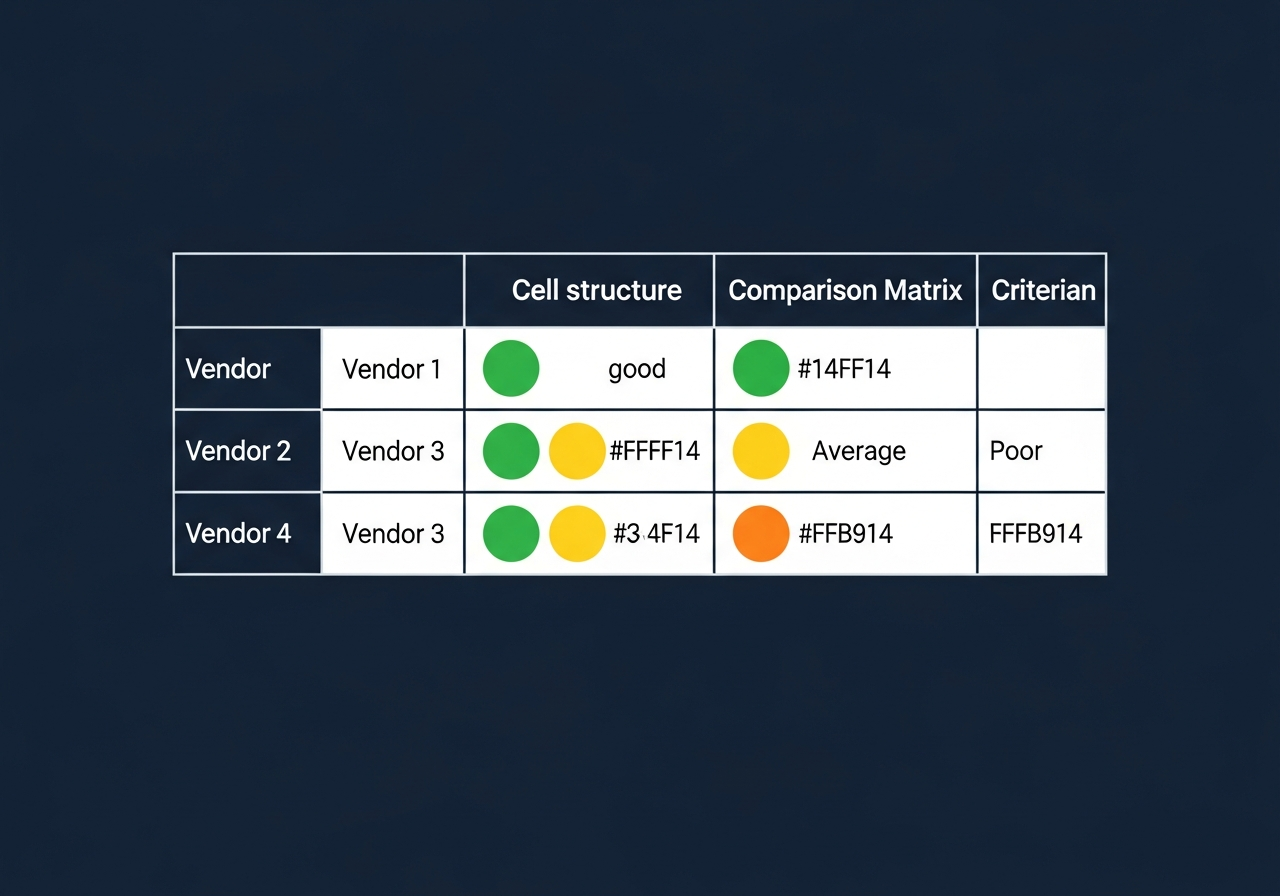
After scoring each vendor individually, create a comparison matrix:
- Normalize scores: Multiply each category score by its weight to get weighted scores.
- Calculate totals: Sum weighted scores for each vendor.
- Identify gaps: Flag any category where a vendor scores below 3 - this is a risk area regardless of total score.
- Reference check the finalists: Only invest time in deep reference checks for your top 2-3 candidates.
- Run a paid pilot: For high-value engagements, commission a small paid discovery or proof-of-concept before committing to a full build.
Recommended category weights
- Technical capability: 30%
- Delivery process: 25%
- Communication: 20%
- Pricing: 15%
- References: 10%
Adjust these based on your context. If you are in a regulated industry, you might increase technical capability to 35% and add a compliance sub-category.
Putting the scorecard to work
The best evaluation process combines structured scoring with unstructured judgment. Use the scorecard to create a defensible shortlist, then make the final decision based on the team you will actually work with day to day.
Run this process with your full stakeholder group - engineering, product, procurement, and legal. Misalignment on vendor selection criteria causes friction throughout the engagement.
Need help evaluating vendors or want a second opinion on proposals you have received? CoreLine provides vendor-neutral software development consulting to help you make confident, unbiased decisions about your technology partnerships.