


Introduction
Selecting a partner for a high-stakes digital product is rarely about features alone. It’s a decision about speed, risk, governance, and how well a team can collaborate under real constraints. Traditional RFPs and slide‑based pitches are optimized for describing capability-not proving it where it matters: in working software.
A proof‑of‑value (PoV) pilot flips the script. Instead of awarding a multi‑month contract based on promises, you run a tightly scoped, time‑boxed engagement-typically 3–6 weeks-that delivers a meaningful slice of functionality, validated user experience, and measurable engineering quality. The result is evidence: how the prospective partner estimates, designs, ships, and communicates when outcomes-not decks-are on the line.
At CoreLine, we encourage product leaders to use PoV pilots as an intentional “stage gate” before committing to a full engagement with a custom web app development agency, digital product design agency, or mobile app consulting partner. Below is a practical blueprint you can lift and run.
Event/Performer Details
- What: Proof‑of‑Value Pilot (time‑boxed vendor evaluation)
- Duration: 3–6 weeks (common sweet spot is 20–25 working days)
- Scope pattern options:
- A thin end‑to‑end user flow (from UI to database) for your core value proposition.
- A risky integration (e.g., SSO, payments, core ERP/CRM, or data ingestion pipeline).
- A performance‑critical component (e.g., search, offline sync, or large list virtualization).
- Team (“Performer”): Cross‑functional partner squad-product, UX/UI, tech lead, 1–2 developers, QA/automation engineer; plus your product owner and a technical stakeholder.
- Primary outputs: Running code in your cloud, design artifacts, test suite, decision‑ready metrics, and an executive readout with a keep/stop/next recommendation for enterprise application development scale‑up.
Why You Shouldn’t Miss It
- Evidence over claims: See how a team performs under your real constraints-tech stack, security, and governance.
- Faster, cheaper diligence: Replace months of RFP cycles with weeks of hands‑on collaboration and measurable outputs.
- Risk targeting: De‑risk the spikiest part of your roadmap first (compliance, integration, performance).
- Comparable scoring: Evaluate multiple partners against the same success criteria and time box.
- Smoother kickoff: Reuse pilot artifacts (architecture spikes, UI patterns, CI/CD) to accelerate the main engagement.
- Cultural fit: Observe day‑to‑day behaviors-communication, documentation, and stakeholder management-that decks can’t reveal.
- Budget transparency: Validate pricing models and productivity before committing significant spend on MVP development services.
Practical Information
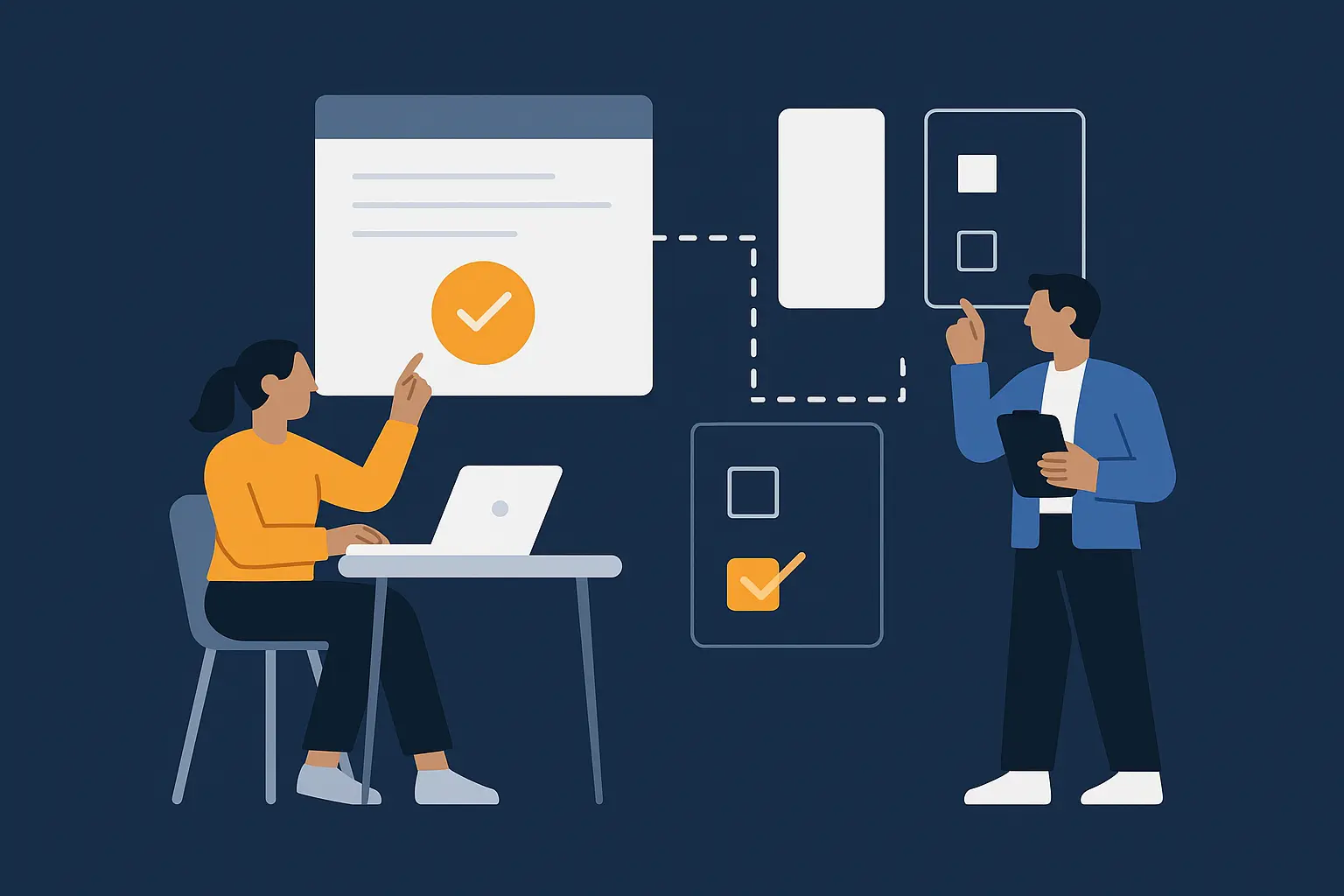
The PoV structure that works
- Define “value” up front
- Business outcomes: What should change in the next 3–6 weeks? Examples: validate a conversion‑critical flow, unblock SSO, cut a manual process by 50%.
- User outcome: Which job‑to‑be‑done will be demonstrably better?
- Technical outcomes: What non‑functional targets matter now? (e.g., P95 latency < 400ms for search results; cold start < 1s for critical view; error rate < 0.2%.)
- Decision criteria: What will make you say “yes” to scaling with this partner?
- Time‑boxed cadence (example 4‑week plan)
- Week 0 (prep): Access, environments, data fixtures, security review, success criteria sign‑off.
- Week 1: Discovery mini‑sprint-business mapping, domain language, success metrics instrumentation plan. UX wireframes and architecture spike.
- Week 2: Build the vertical slice; establish CI/CD, trunk‑based development, and basic test pyramid.
- Week 3: Usability validation with 3–5 target users or internal proxies; harden integration; introduce observability (logs, traces, key dashboards).
- Week 4: Perf pass, accessibility pass, security checklist; executive readout and code/asset handover.
- Outputs you should expect
- Running code in your cloud subscription (or a segregated tenant) with audit trail.
- Design artifacts: annotated wireframes/flows; component tokens; microcopy.
- Engineering assets: repo with commit history, tests, ADRs (Architecture Decision Records), IaC scripts, monitoring dashboards.
- Measurement: before/after metrics tied to goals; defect rates; velocity; deployment frequency.
- Readout: concise evidence and recommendation to proceed, adjust, or stop.
A scoring rubric to compare agencies apples‑to‑apples
Weight categories based on your priorities; the example below totals 100 points.
- Business impact (25): Did the pilot demonstrably improve the targeted KPI or de‑risk the chosen area?
- UX quality (15): Task success, clarity of interaction, accessibility checks (WCAG quick pass), and handoff quality.
- Technical excellence (25): Code clarity, test coverage and relevance, ADR quality, observability set‑up, performance vs. targets.
- Delivery and collaboration (20): Estimate fidelity, sprint hygiene, communication, risk management, and change control.
- Security/compliance (10): Data handling, secrets management, RBAC, dependency posture.
- Handover/readiness (5): Can you continue independently? Are assets self‑documented?
Pro tip: Ask each custom web app development agency to self‑score after the readout and present deltas versus your internal score. The conversation will surface blind spots and alignment-or lack thereof.
Choosing the right pilot scope
Good scopes are:
- Thin but valuable: a full user path end‑to‑end, not a back‑office screen disconnected from outcomes.
- Constrained: fit in 3–6 weeks for a standard squad (avoid “everything important”).
- Representative: exercises your real constraints-legacy API quirks, data volume, permission rules, or design system.
Avoid:
- “Hello World” playgrounds that mask integration pain.
- Purely cosmetic demo screens with no data or logic.
- POCs that can’t be productionized (e.g., throwaway tech or vendor‑locked tooling you won’t use later).
Governance and transparency
- RACI: Product owner (you), delivery lead (partner), tech lead (partner), security reviewer (you), legal/procurement (you), QA owner (partner).
- Working agreements: Daily async updates; twice‑weekly 25‑minute checkpoint; one weekly demo; Slack/Teams channel with 24‑hour response window.
- Visibility: Shared backlog with tags (Pilot/Out‑of‑scope/Blocked), public burndown, and a decisions log (ADRs).
- Change control: Anything outside the scope requires a written trade-drop item X to add Y, with updated risks.
Pricing and IP
- Structure: Fixed‑fee for time box or capped time‑and‑materials with transparent timesheets; both cap downside risk.
- IP: You own all pilot outputs upon payment, including code, designs, and scripts.
- Reuse credit: If you scale with the partner within 60 days, apply a portion of pilot fees to the main project. This aligns incentives without pressuring your decision.
Security and compliance essentials
- Access: Principle of least privilege; time‑boxed accounts; no production PII in pilot environments.
- Data: Use synthetic or masked datasets; document data lineage for any analytics.
- Tooling: Secrets in vaults; dependency scanning; minimal set of approved extensions/add‑ons.
- Audit: Keep a one‑page checklist (auth, data retention, logging, encryption in transit/at rest) with sign‑off.
Instrumentation from day one
Even in a pilot, measure what matters:
- Product: conversion for the test flow, task completion time, drop‑off by step.
- Engineering: deployment frequency, lead time for changes, change failure rate, mean time to restore (MTTR) if applicable.
- Experience: P95/P99 latency of critical interactions; accessibility quick checks; error budgets aligned to your SLOs.
Red flags during a pilot
- Decks instead of demos: more slides than commits.
- Over‑optimistic estimates with late scope cuts and no trade proposals.
- Opaque repos or “we’ll share later.”
- Ignoring non‑functional requirements because “it’s just a pilot.”
- No ADRs: big decisions are implicit and undocumented.
- Handover friction: the code runs only on the partner’s laptop or cloud.
How CoreLine runs PoV pilots
For organizations comparing partners for enterprise application development, we tailor a pilot around your riskiest assumption and your decision criteria. Our standard squad blends product consulting with hands‑on engineering and UX/UI design. You’ll see how we handle:
- Product framing: a concise problem statement, measurable outcomes, and an explicit “Definition of Value.”
- Design craft: wireframes to clickable prototypes, component tokens, and microcopy that supports conversion.
- Engineering discipline: ADRs, test strategy, CI/CD from day one, and observability.
- Platform pragmatism: we work within your stack and constraints, whether the next step is scaling an MVP, integrating enterprise SSO, or standing up a cloud‑ready mobile backend.
- Communication: short, frequent demos and written updates so C‑level stakeholders and product managers can track progress without ceremony.
This approach is equally effective whether you seek MVP development services to validate a market opportunity, mobile app consulting to prove a complex native feature, or a digital product design agency to advance a design system with accessible, production‑ready components.
Templates you can reuse
- Pilot Charter: goals, scope, constraints, success metrics, timeline, team, and governance.
- Success Criteria Matrix: business/UX/technical measures with target vs. actual.
- Risk Register: top risks, likelihood/impact, response plans; reviewed twice weekly.
- ADR Pack: short decisions log with context, options considered, and consequences.
- Readout Deck (10–12 slides): goals, highlights, key metrics, demo links, code locations, recommendations.
What “good” looks like at the end of a PoV
- You can run the demo yourself in your environment.
- Stakeholders can trace decisions via ADRs and see trade‑offs.
- Metrics show either value achieved or a clear learning that changes your roadmap with confidence.
- There’s a credible plan to scale-team shape, risks, and a 30/60/90‑day delivery outline-should you proceed.

Two anonymized patterns we’ve seen work
- Global manufacturer, internal platform: A 4‑week pilot replaced a 14‑page RFP appendix by proving a secure OIDC integration and role‑based permissions in a thin path. Outcome: 80% reduction in onboarding time for a pilot user group; partner selected with a clear backlog for Phase 1.
- Fintech scale‑up, mobile re‑platform: A 5‑week pilot delivered a native performance‑sensitive feature plus an analytics taxonomy and lightweight design tokens. Outcome: measured 42% faster task completion on the key flow and a shared understanding of “performance budgets” for subsequent sprints.
Conclusion
A proof‑of‑value pilot isn’t extra work-it’s concentrated learning that replaces guesswork with evidence. You’ll compress diligence, minimize risk, and start your engagement on real momentum, whether your next milestone is hardening an MVP, scaling a platform, or proving a complex mobile capability.
If you’re planning to hire a custom web app development agency or weigh options across digital product design and mobile app consulting, let’s design a PoV pilot that answers your most important question first.
Ready to move from decks to data? Talk to our team about a tailored pilot for your initiative: Contact CoreLine